 Daily Knowledge
 "To err is human; to forgive, divine."
[Alexander Pope]
Quote of the Day, from brainyquote.com (2026/09/07)
Article of the Day

George Krugers (1890–1964) was a filmmaker active in the Dutch East Indies during the early 20th century. Born in Banda Neira, he migrated to Java in the 1920s and spent time in Surabaya before moving to Bandung. There, he worked with L. Heuveldorp on the colony's first feature film, Loetoeng Kasaroeng (The Mystical Monkey), before making his directorial debut in 1927 with Eulis Atjih. He established the Krugers Film Company and joined the Hajj in 1928 to produce Het Groote Mekka-Feest (The Great Mecca Feast), considered the first documentary film about the Hajj. In 1930, Krugers began producing sound films, with his Karnadi Anemer Bangkong (Karnadi the Frog Contractor, 1930) likely the first domestic sound film in the Indies. After this failed commercially, Krugers worked for Tan's Film. Amidst the Great Depression, he moved to Hong Kong, but found no work. Krugers spent the rest of his life in the Netherlands. Aside from Het Groote Mekka-Feest, all of his films are considered lost. (Full article...)
Current Events

BBC One-minute World News
Fast briefed every day.
- Trump pleads not guilty to 34 felony counts (1970-01-01 01:00)
- Haberman reveals why Trump attacked judge and his family in speech (2023-04-05 15:30)
- What to know about the Trump indictment on the eve of his court appearance (2023-04-06 00:50)
- READ: Trump indictment related to hush money payment (1970-01-01 01:00)
- Russian authorities detain suspect over St. Petersburg cafe blast (1970-01-01 01:00)
Image of the Day

Source: Wikimedia Commons.
On this day: September 7
September 7: Labour Day in Canada and Labor Day in the United States (2026)
.svg)
- 1652 – Chinese peasants on Formosa (now Taiwan) began a rebellion against Dutch rule which was suppressed four days later.
- 1822 – Pedro I declared the independence of Brazil from Portugal, establishing the Empire of Brazil (flag pictured).
- 1936 – The last thylacine died in captivity in Hobart Zoo, Australia.
- 1986 – Desmond Tutu became the first black leader of the Anglican Church of Southern Africa.
- 2004 – Hurricane Ivan made landfall on Grenada, devastating at least 85 per cent of buildings on the island.
- Gregory Bicskei (d. 1303)
- John Shakespeare (d. 1601)
- Ersin Tatar (b. 1960)
- Elinor Barker (b. 1994)
Knowledge about Earth

Facts and Figures
- Age of Earth: ~ 4.568 billion years
- World Population: 7.3 billion (July 2015)
- Continents: 7 (Asia, Africa, North America, South America, Antarctica, Europe, and Australia)
- Mean Radius: 6371.0 km
- Axial Tilt: 23,44°
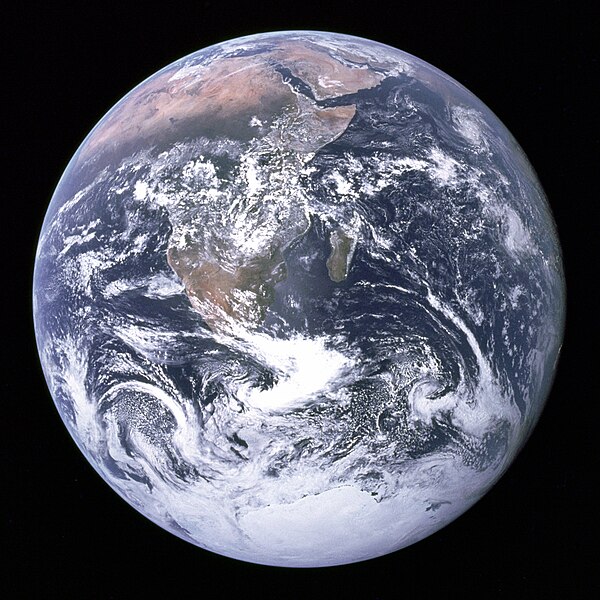
Image Source: Wikipedia - License: Public Domain (thanks to NASA)

Our Solar System
Our solar system consists of
1 star (Sun) and 8 planets (Mercury, Venus, Earth, Mars, Jupiter, Saturn, Uranus and Neptune).
- 1 AU (astronomical unit) is roughly the distance between Earth and the Sun (about 150 million kilometres).
- The space probe Voyager 1 was launched by the NASA in 1977 and is meanwhile (autumn 2015) about 133 AU away from Earth.
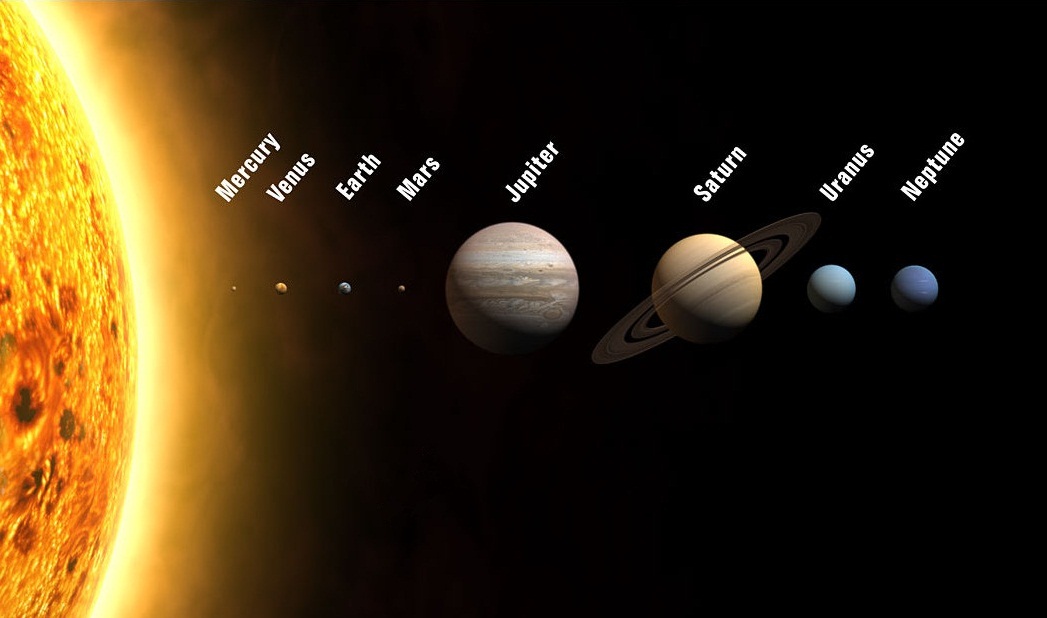
Image Source: Wikipedia - License: CC BY-SA 3.0
Why you should extend your general knowledge:
There are many reasons why one should or wants to extend his knowledge.
First you should consider that "general knowledge" is knowledge which a group of humans - who belong together regional, temporal or otherwise - owns. Thus, it describes a basic understanding of specific categories of knowledge.
As the English philosopher Francis Bacon said before: "Wisdom is Power" [Bacon 1597].